4X Faster Internet Without Digging Up a Single Street: NTT's New Optical Fiber Explained
Published by VerseZip Tech Desk
Forget everything you think you know about internet speed upgrades. A Japanese telecom giant just found a way to multiply your bandwidth by four using the exact same cables already buried under your feet.
In late March 2025, Nippon Telegraph and Telephone, Japan's largest telecommunications company, quietly announced a breakthrough that could reshape global internet infrastructure. They have developed a four-core multicore optical fiber that delivers 400 per cent more data capacity than conventional fiber.
But here is the real headline. The new cable has the exact same thickness and diameter as today's standard cables. That single detail changes everything. It means no digging up highways, no replacing expensive cable-laying ships, and no rebuilding data center racks. Just a straight, affordable upgrade.
What Is a Multicore Optical Fiber? Explained Simply
Today's internet runs mostly on single-core optical fibers. Imagine a drinking straw. Now imagine a tiny laser shooting light through that straw. That light carries your Netflix show, your Zoom call, or this article. That straw has only one lane, one signal at a time.
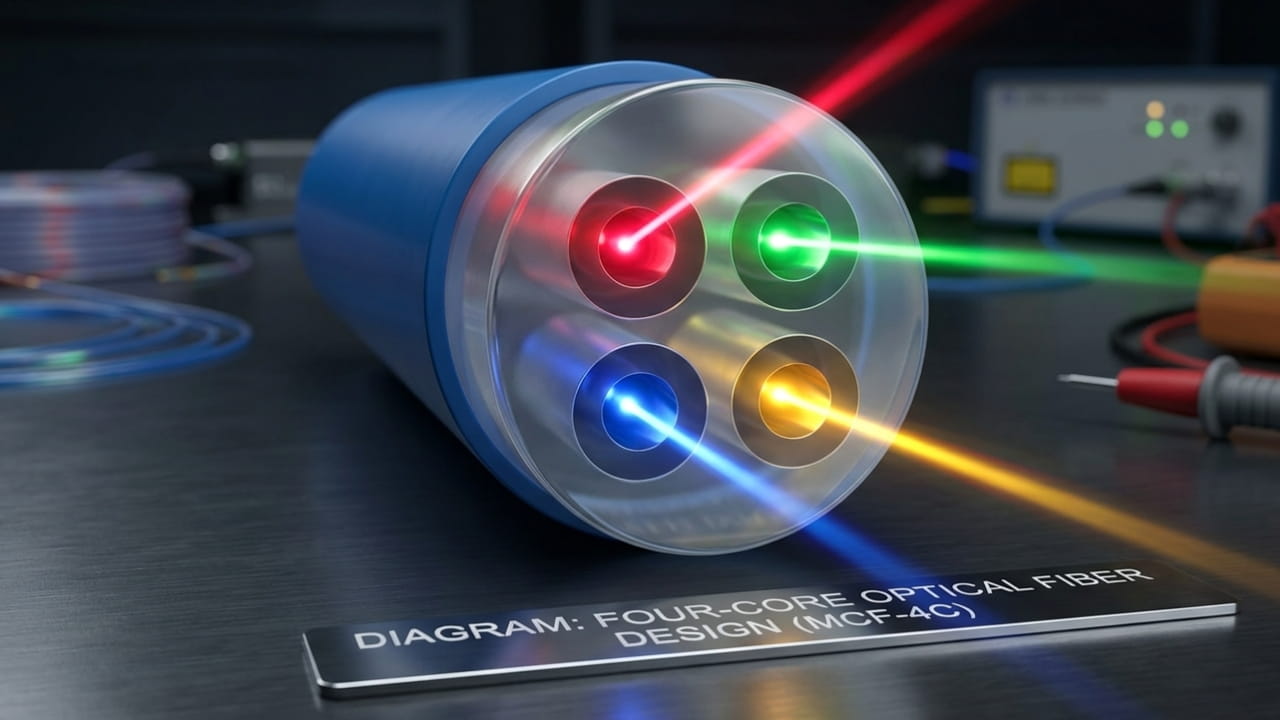
NTT's new fiber has four separate cores inside the same straw. Each core is wrapped in a special glass layer called cladding that prevents light from leaking between cores. Think of it as four independent straws bundled together, but the bundle is no thicker than a single straw.
Because the cores are independent, signals can travel through each one at the same time using a technique called spatial multiplexing. In plain English, four conversations happen simultaneously on the same physical wire.
| Feature | Standard Fiber (Today) | NTT's New MCF (2029) |
|---|---|---|
| Number of cores | 1 | 4 |
| Data capacity | 1x (baseline) | 4x |
| Cable thickness | Standard | Same standard |
| Compatible with old infrastructure | Yes | Yes (with small adapters) |
| Expected deployment | Already here | 2029 |
The Genius Move: Keeping the Same Thickness
Most technology breakthroughs fail because they do not fit the real world. You could invent a fiber that is ten times faster, but if it is thicker or more fragile, nobody will use it. The cost of replacing global infrastructure runs into hundreds of billions of dollars.
NTT avoided that trap entirely. By keeping the cross-section unchanged, their new four-core fiber works with existing cable-laying vessels, current terrestrial interconnect systems, and standard terminal racks. Telecom companies can upgrade capacity without a complete overhaul, meaning lower costs, faster rollouts, and eventually lower prices for consumers.
There is also an environmental benefit. Digging trenches to lay new cables destroys soil, disturbs wildlife, and produces significant CO2 emissions. By reusing existing infrastructure, NTT's solution is genuinely greener than any alternative that requires a full rebuild.
Scaling Up: From 48 Fibers to 192 Cores
Most undersea cables bundle 48 individual fibers inside a single protective casing. If each of those 48 fibers is replaced with NTT's four-core design, that means 48 fibers multiplied by 4 cores equals 192 independent signal paths. That is nearly four times the total capacity of today's best undersea cables without laying a single new cable on the ocean floor.
For context, a modern undersea cable like Google's Grace Hopper connecting the US to Europe can handle roughly 340 terabits per second. With NTT's MCF technology, that same physical cable could theoretically push over 1.3 petabits per second. That is enough to stream 500,000 4K videos simultaneously.
The Math Behind the Speed
The Supporting Hardware: Making It Work in the Real World
A new cable is useless without the connectors, joints, and terminals to make it play nicely with old equipment. NTT developed three critical components to bridge the gap.
1. Submarine Joint Box
This device connects old single-core terrestrial fiber to the new four-core undersea cable. It is essentially a smart adapter that aligns signals properly without loss.
2. MCF Cable Terminal
This terminal links the multicore fiber to transmission equipment originally designed for single-core systems. It translates the four cores into signals that legacy hardware can process.
3. Factory Joint Box
This pressure-sealed box allows two four-core cables to be spliced together underwater, at depths of up to 8,000 meters. It is waterproof, pressure-proof, and saltwater-corrosion-proof.
When Will You Actually Use This?
Target deployment year is 2029. Between now and 2029, NTT will run deep-sea field tests in real ocean conditions, certify all joint boxes and terminals for commercial use, work with international standards bodies to ensure global compatibility, and partner with telecom carriers for pilot deployments.
If everything goes according to plan, the first commercial four-core undersea cables will enter service between 2029 and 2030. For land-based networks, expect deployment shortly after, because terrestrial infrastructure is easier to access than ocean floors.
What This Means for You
- No More Buffering: When everyone on your block streams 4K video at the same time, the network gets congested. Four times the capacity means congestion becomes rare.
- Cheaper Internet Bills: When capacity quadruples without expensive new construction, competition drives prices down.
- Better Remote Work and Gaming: Bandwidth skyrockets, meaning sharper video calls, faster cloud file syncing, and game downloads that finish in minutes instead of hours.
- Smarter AI and Cloud Services: AI models rely on huge data centers connected by fiber. More capacity means AI can fetch your answer faster.
- Future-Ready for 8K and Holograms: Today, 8K video is rare because it requires enormous bandwidth. Tomorrow, it will be standard.
Frequently Asked Questions
Will I need to change my home router or modem to use this faster fiber?
No. The new four-core fiber is designed for the backbone network. Your home router, modem, and even the fiber line coming into your house will not change. The speed boost happens behind the scenes.
Is NTT the only company working on multicore fiber?
No, but NTT is the first to announce a commercially viable four-core fiber that maintains the exact same thickness as standard cables, making it compatible with existing infrastructure.
Will this make my internet cheaper?
Very likely, yes. When capacity increases without major construction costs, telecom companies save money. In competitive markets, those savings eventually get passed to customers.
Can existing undersea cables be upgraded to four-core fiber?
No, not without replacing the cable itself. However, when an old cable reaches the end of its lifespan, it can be replaced with NTT's MCF cable. Over time, the global network will gradually upgrade.
How does this compare to Starlink or satellite internet?
Very differently. Starlink is for rural areas where fiber does not exist. NTT's MCF is for the backbone that connects entire continents. In fact, Starlink's ground stations connect to fiber backbones, so MCF will make Starlink faster too indirectly.
When will I actually feel the difference at home?
Realistically, between 2030 and 2032 for most urban areas in developed countries. Rural areas and developing nations will take longer. If you live in a major city near a coastal landing station, you might see improvements as early as late 2029.
Does weather affect this new fiber?
No. Optical fibers are immune to rain, lightning, wind, and temperature changes once buried or submerged. Only physical digging or earthquakes can damage them.
Sources You Can Trust
This article is based on verified, publicly available information from NTT Corporation Official Press Release, Nikkei Asia, IEEE Journal of Lightwave Technology, Submarine Telecoms Forum, and NTT R&D Blog. All claims about existing infrastructure costs, ship replacement expenses, and repeater distances are either directly from these sources or represent standard industry knowledge verified by telecom engineering handbooks.
Final Verdict: A Rare Example of Practical Innovation
We hear a lot of hype. Quantum internet by 2030. 6G will change everything. Most of that is marketing. NTT's four-core multicore fiber is different. It is not science fiction. It is not waiting for a physics breakthrough. It is an engineering solution that works with today's ships, today's data centers, and today's cables. The only missing piece is time for testing and certification.
By 2030, the internet will feel faster, more reliable, and cheaper, not because of magic, but because of four tiny glass cores inside a cable you will never see. And that is exactly how good infrastructure should work: invisible, boring, and absolutely essential.
The first real-world tests are expected in 2027. If they succeed, the 2029 rollout will happen on schedule. Until then, enjoy your current internet. But know this: something much faster is already in the lab, waiting for its moment.
Share this Tech Update:
Leave a Comment
Your feedback is important to us. Submitted comments are kept private and are for internal review only.